Introduction: Parking Is Entering a New Technological Era
Introduction: Parking Is Entering a New Technological Era
Urban India is growing rapidly. With rising vehicle ownership, expanding commercial spaces, and increasing mobility demands, traditional parking systems are no longer sufficient.
Manual ticketing. Cash payments. Static pricing. Human-dependent enforcement.
These legacy models are inefficient, prone to revenue leakage, and unable to meet modern expectations.
We are now entering the next era of parking management—driven by Artificial Intelligence (AI), Automatic Number Plate Recognition (ANPR), and end-to-end automation.
For property developers, mall operators, airports, IT parks, and smart city planners, these technologies are not just upgrades—they are strategic infrastructure investments.
Why Traditional Parking Systems Are Failing
Before understanding the future, we must examine the limitations of the past:
- Long entry and exit queues
- Manual errors in billing
- Ticket loss disputes
- Revenue leakage due to cash handling
- Lack of real-time occupancy visibility
- No actionable data insights
As urban traffic increases, these inefficiencies multiply.
Technology-driven parking solutions eliminate these friction points.
Artificial Intelligence (AI): The Brain Behind Smart Parking
AI in parking management goes far beyond automation—it introduces predictive intelligence.
How AI Is Transforming Parking
Predictive Demand Forecasting
AI analyzes:
- Historical occupancy data
- Time-based trends
- Event schedules
- Seasonal footfall
This enables operators to:
- Adjust pricing dynamically
- Prepare for peak demand
- Optimize staffing
Dynamic Pricing Optimization
AI enables surge-based pricing models similar to ride-hailing platforms.
Higher demand → Optimized pricing
Lower demand → Incentivized discounts
This maximizes revenue per parking bay without expanding infrastructure.
Behavioral & Traffic Pattern Analysis
AI dashboards help operators understand:
- Average parking duration
- Peak congestion times
- Zone-based occupancy
These insights improve layout planning and operational decisions.
ANPR (Automatic Number Plate Recognition): The Key to Seamless Entry & Exit
ANPR technology uses high-resolution cameras and optical character recognition to detect vehicle number plates instantly.
How ANPR Works
- Vehicle approaches entry
- Camera captures number plate
- Software reads & verifies plate
- System automatically logs entry
- Barrier opens without ticket issuance
At exit:
- Vehicle is identified instantly
- Charges are calculated automatically
- Payment processed digitally
- Barrier opens within seconds
Benefits of ANPR in Parking Management
Ticketless Experience
No physical tickets. No loss. No disputes.
Faster Throughput
Entry/exit time reduces drastically, especially during peak hours.
Improved Revenue Accuracy
Each vehicle is digitally logged—eliminating manual discrepancies.
Enhanced Security
Vehicle movement is recorded and traceable.
Contactless & Cashless Integration
ANPR integrates seamlessly with:
- FASTag
- UPI
- Mobile apps
- Corporate parking memberships
Automation: The Backbone of Modern Parking Infrastructure
Automation connects hardware, software, and analytics into one seamless ecosystem.
Key Automated Parking Components
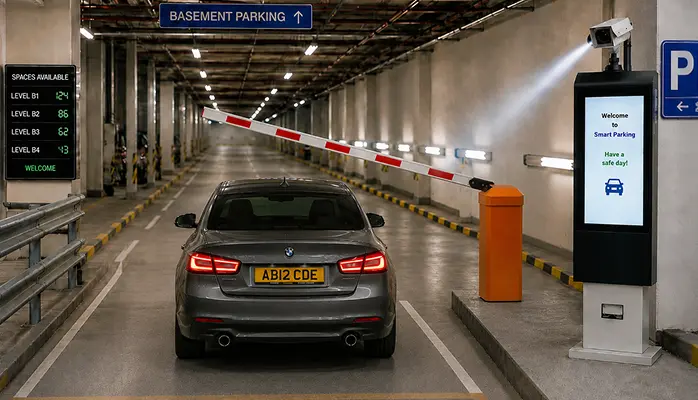
- Smart boom barriers
- Digital ticket dispensers
- Parking guidance systems
- Digital level displays
- Central monitoring dashboards
- Mobile cashiering systems
Automation ensures:
- Consistency
- Speed
- Error reduction
- Centralized control
How Automation Improves Commercial Real Estate Performance
For Shopping Malls
- Reduced entry congestion
- Improved shopper satisfaction
- Increased dwell time
- Higher repeat visits
For Airports & Metro Stations
- Rapid throughput
- Reduced boarding delays
- Better traffic discipline
Data: The Hidden Power of AI & ANPR
Modern parking systems generate enormous volumes of data.
When structured properly, this data helps operators:
- Forecast revenue
- Monitor occupancy in real time
- Identify underperforming zones
- Plan expansions
- Improve staffing models
Parking is no longer just operational—it becomes analytical and strategic.
Safety & Security in the AI-Driven Era
AI-enabled parking enhances safety through:
- Suspicious vehicle tracking
- Overstay alerts
- Blacklisted vehicle detection
- Incident time-stamping
- Audit trail generation
For high-footfall locations like malls and airports, this significantly strengthens compliance and surveillance capability.
Sustainability & Smart Cities Integration
AI and automation also support environmental goals:
- Reduced vehicle circulation time
- Lower carbon emissions
- Efficient traffic distribution
- Integration with smart city command centers
Parking is becoming a crucial component of urban mobility planning.
Challenges in Adopting AI & ANPR (And How to Overcome Them)
Challenge 1: Infrastructure Integration
Solution: Phased implementation with modular upgrades.
Challenge 2: Data Security Concerns
Solution: Encrypted systems, compliant software architecture.
Challenge 3: Initial Investment
Solution: Long-term ROI modeling shows increased revenue and reduced operational costs offset installation expenses.
The Business Case: Why AI & Automation Are Strategic Investments
Implementing AI, ANPR, and automation leads to:
✔ Reduced manpower dependency
✔ Increased operational transparency
✔ Higher revenue per bay
✔ Faster vehicle throughput
✔ Enhanced user satisfaction
✔ Stronger security & compliance
In large commercial assets, even small efficiency gains translate into significant financial returns.
The Next 5 Years: What to Expect
The future of parking will likely include:
- Fully ticketless environments
- App-based pre-booking & reservations
- AI-based parking space prediction
- Electric vehicle charging integration
- Cloud-based centralized parking networks
Parking will no longer be a backend utility—it will be a digitally managed mobility service.
Conclusion: The Next Era Has Already Begun
AI, ANPR, and automation are not experimental technologies—they are becoming the industry standard.
For commercial real estate, malls, airports, IT parks, and smart cities, adopting intelligent parking solutions is essential for:
- Operational efficiency
- Revenue growth
- Customer satisfaction
- Sustainable urban development
The next era of parking management is data-driven, automated, and seamless.
The question is no longer if this transformation will happen—but who will lead it.
Frequently Asked Questions
AI in parking management uses data analytics, machine learning, and predictive algorithms to optimize parking demand, improve traffic flow, enable dynamic pricing, and enhance operational efficiency.
ANPR (Automatic Number Plate Recognition) uses high-resolution cameras and optical character recognition technology to automatically detect and record vehicle number plates at entry and exit points, enabling ticketless and seamless parking operations.
ANPR-based parking reduces entry and exit time, eliminates ticket loss issues, improves revenue accuracy, enhances security tracking, and enables contactless payment integration.
Automation reduces manual errors, prevents revenue leakage, enables dynamic pricing, improves throughput, and provides real-time analytics that help maximize revenue per parking bay.
Yes. AI-powered parking systems are highly effective in high-footfall environments like malls, airports, IT parks, and metro stations where speed, security, and operational efficiency are critical.
Yes. By reducing entry/exit delays, providing real-time occupancy updates, and optimizing vehicle flow, AI and ANPR significantly reduce internal congestion and vehicle circulation time.
Modern AI and ANPR systems use encrypted software architecture, secure data storage, and monitored access control to ensure compliance, security, and vehicle traceability.