Introduction: Parking Is Evolving
Parking systems in India have traditionally relied on manual processes — paper tickets, cash payments, manual logs, and human verification. While these systems worked in the past, today’s high-traffic malls, airports, IT parks, metro stations, and commercial complexes require speed, transparency, and technology.
The shift toward ticketless parking systems powered by ANPR, AI, and automation is redefining how parking facilities operate.
In this blog, we compare Traditional Parking vs Ticketless Parking across operational efficiency, revenue, security, scalability, and customer experience — and explore why the future belongs to smart parking ecosystems
What Is Traditional Parking?
Traditional parking systems typically include:
- Manual ticket issuance at entry
- Physical paper tickets
- Cash-based payment at exit
- Manual reconciliation of collections
- Staff-dependent validation
- Limited reporting or analytics
These systems are manpower-heavy and prone to operational challenges, especially in high-footfall environments.
What Is Ticketless Parking?
Ticketless parking eliminates physical tickets by using technologies such as:
- ANPR (Automatic Number Plate Recognition)
- RFID tags
- FASTag integration
- Mobile app-based identification
- Automated entry/exit barriers
- Cloud-based billing systems
Vehicle number plates become the digital identity, enabling seamless and automated parking experiences.
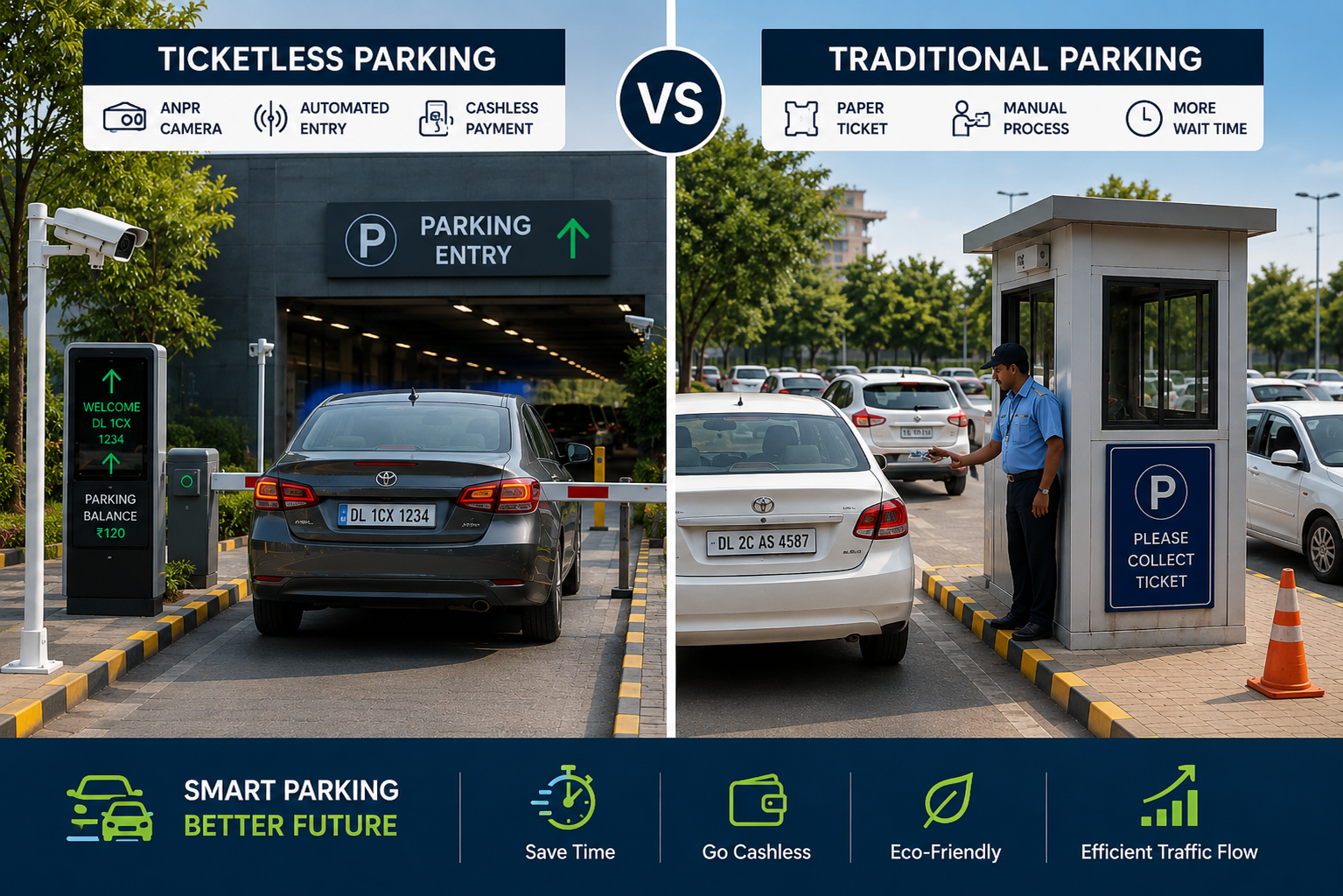
Side-by-Side Comparison: Ticketless vs Traditional Parking
Entry & Exit Speed
Traditional Parking
- Driver stops
- Ticket printed
- Manual handover
- Payment queue at exit
- Ticket verification
⏱ Slower throughput, especially during weekends and peak hours.
Ticketless Parking
- Camera scans number plate
- Barrier opens automatically
- Payment linked digitally
- Instant exit validation
⚡ Significantly faster vehicle movement.
Winner: Ticketless Parking
Revenue Transparency & Leakages
Traditional Parking
- Cash handling risks
- Manual billing errors
- Ticket manipulation possibilities
- Delayed reconciliation
Revenue leakage is common in high-volume locations.
Ticketless Parking
- Digital transaction logs
- Automated billing calculation
- Real-time dashboards
- Integrated payment gateways
Higher transparency and audit control.
Winner: Ticketless Parking
Customer Experience
Traditional Parking
- Ticket loss disputes
- Waiting in exit queues
- Cash-only inconvenience
- Frustration during peak traffic
Ticketless Parking
- Contactless entry & exit
- No physical ticket dependency
- UPI / digital payment options
- Seamless and modern experience
Modern customers expect frictionless service.
Winner: Ticketless Parking
Security & Monitoring
Traditional Parking
- Limited tracking capability
- No automatic vehicle history
- Manual record keeping
Ticketless Parking
- Vehicle movement logs
- Entry/exit timestamp records
- Blacklisted vehicle detection
- Suspicious vehicle alerts
Enhanced compliance and traceability.
Winner: Ticketless Parking
Operational Efficiency
Traditional Parking
- High manpower dependency
- Manual reporting
- Limited scalability
Ticketless Parking
- Centralized monitoring
- Automated reporting
- AI-based analytics
- Reduced manpower dependency
Lower operational cost over time.
Winner: Ticketless Parking
Scalability for Large Assets
Traditional Parking
Scaling requires:
- More staff
- More manual counters
- Higher error risks
Ticketless Parking
Scaling requires:
- Additional cameras
- System expansion
- Software upgrades
Much easier to scale across multiple properties.
Winner: Ticketless Parking
Where Traditional Parking Still Exists
Traditional systems may still be used in:
- Small residential complexes
- Low-traffic public parking
- Temporary event parking
- Rural locations
However, as vehicle density grows, even these segments are moving toward automation.
Why Ticketless Parking Is the Future of Indian Cities
India’s commercial real estate is expanding rapidly. Malls, IT parks, airports, metro stations, and smart cities require:
- Faster throughput
- Reduced congestion
- Transparent revenue systems
- Enhanced safety
- Sustainable mobility
Ticketless parking directly addresses all these needs.
Role of ANPR in Ticketless Parking
ANPR is the backbone of ticketless systems.
It:
- Reads number plates instantly
- Logs vehicle data
- Integrates with payment systems
- Eliminates physical ticket dependency
This reduces:
- Queue time
- Paper usage
- Manual errors
- Revenue disputes
Financial Impact: ROI Comparison
Traditional Parking
- Lower initial investment
- Higher long-term operational cost
- Revenue leakages
- Limited analytics
Ticketless Parking
- Higher initial setup cost
- Lower recurring manpower cost
- Increased revenue accuracy
- Data-driven optimization
Over time, ticketless systems deliver better ROI due to improved efficiency and reduced losses.
Sustainability Comparison
Traditional Parking
- Paper tickets
- Longer idling times
- Higher fuel consumption in queues
Ticketless Parking
- Paperless operations
- Faster entry/exit
- Reduced congestion
- Lower emissions
Smart parking supports greener mobility goals.
Who Should Adopt Ticketless Parking?
Ticketless systems are ideal for:
- Shopping malls
- Airports
- Metro rail parking
- IT parks
- Corporate campuses
- Convention centers
- Large commercial complexes
High-volume environments benefit the most.
The Strategic Shift: From Parking Utility to Revenue Asset
Ticketless parking transforms parking from:
“Basic vehicle storage”
into
“A digitally managed, revenue-optimized mobility service.”
With real-time data and automation, parking becomes:
- Measurable
- Controllable
- Optimizable
- Scalable
Why Secure Parking India Advocates Ticketless & Automated Systems
With global expertise and pan-India presence, Secure Parking India integrates:
- ANPR-based access systems
- Automated barrier control
- Smart parking management dashboards
- Digital payment integration
- Revenue monitoring tools
The goal is simple:
Deliver seamless parking experiences while maximizing asset performance.
Conclusion: The Choice Is Clear
While traditional parking systems served their purpose in the past, modern urban infrastructure demands smarter solutions.
Ticketless parking:
✔ Reduces congestion
✔ Improves customer satisfaction
✔ Enhances revenue transparency
✔ Strengthens security
✔ Lowers operational inefficiencies
The future of parking management in India is digital, automated, and data-driven.
The transition has already begun.
FAQs
Ticketless parking is a smart parking system that eliminates physical tickets and uses technologies like ANPR (Automatic Number Plate Recognition), RFID, or mobile-based identification to automate vehicle entry, billing, and exit.
Ticketless parking systems use cameras to scan vehicle number plates at entry and exit. The system automatically calculates parking duration and enables digital payment, allowing seamless, contactless exits.
Yes. Ticketless parking offers enhanced security through digital vehicle logs, timestamp tracking, automated monitoring, and real-time reporting — reducing fraud and ticket manipulation.
Key advantages include:
- Faster entry and exit
- Reduced revenue leakage
- Contactless payments
- Real-time data monitoring
- Lower long-term operational costs
Yes. High-footfall locations like malls, airports, IT parks, and commercial complexes benefit significantly from ticketless systems due to improved traffic flow and operational efficiency.
Yes. Automated systems reduce dependency on manual ticketing staff and cash handling personnel, improving operational efficiency while maintaining oversight through centralized monitoring.